• Buttons
  • Capsule
  • Mobius
  • Paper Clip
  • Ring
  • Torus
  • Crystal
  • Grain of Send
  • Gear Cylinder
Object Ramp

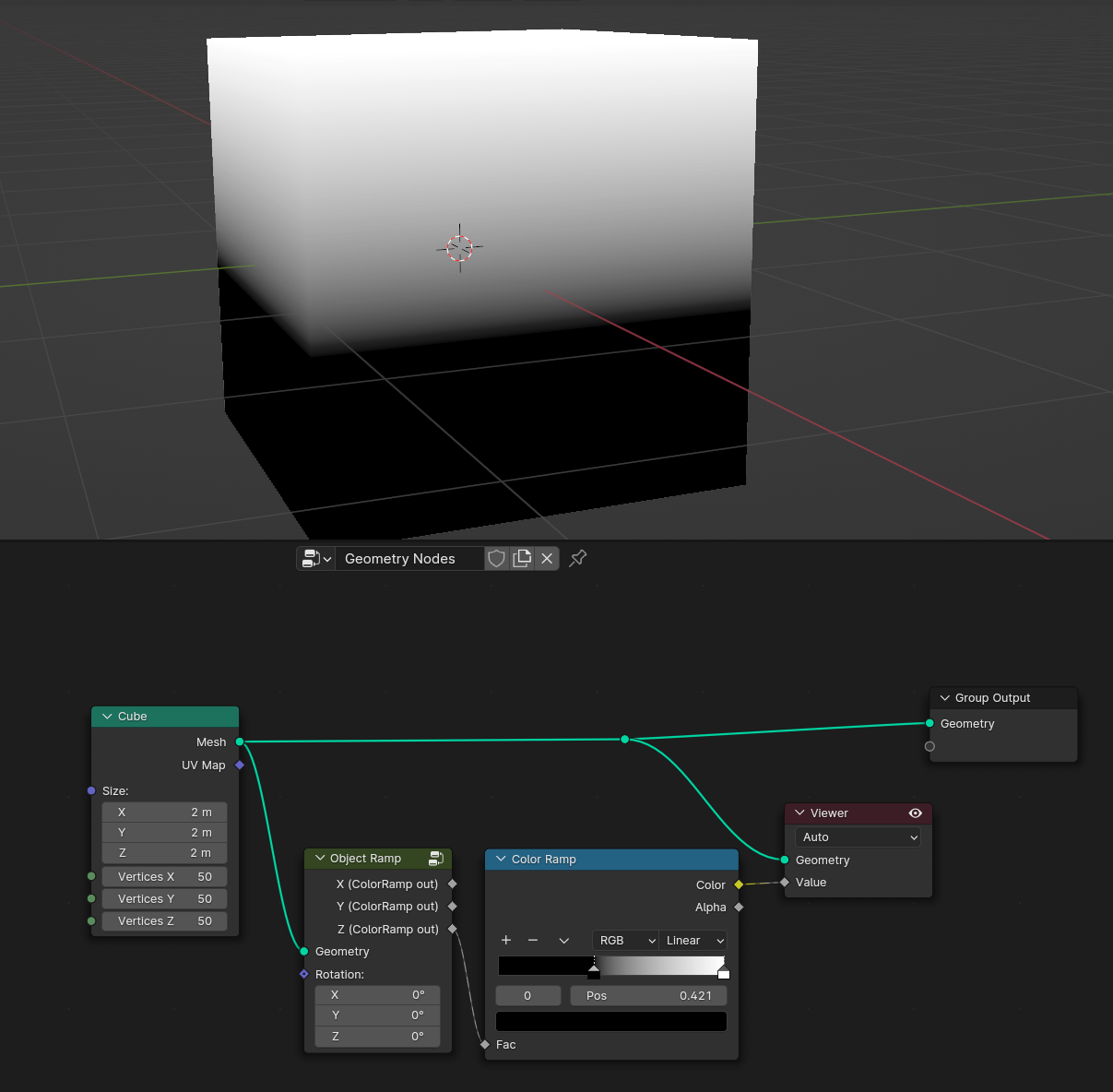
The Object Ramp node generates a gradient across geometry from inputs like position, index, or object size. It’s a core tool for controlling how effects influence geometry, producing normalized 0–1 values.

Settings

Geometry Tabs

  • X/Y/Z – creates a gradient along one of the axes.
    Ignore Object Rotation – Keeps the gradient locked to the world — rotating the object won’t tilt the gradient with it.
    Additional Axes – lets you blend in extra axes alongside the main one, so the gradient can travel diagonally instead of being limited to a single direction.
    Rotate (tab) – spins the gradient freely, so you can aim it in any direction you want — not just along the standard axes.
  • Index Island – gradient across mesh islands by their index.
  • Index Intervala repeating gradient that cycles through a set range of indices. Great for wave-like effects.
    Interval — how many indices fit in one gradient cycle (1 = per index, 4 = every 4 indices).
    Offset — shifts the cycle along the indices.
  • Mesh Center–radial gradient spreading outward from the mesh center.
    Offset — shifts the point used as the center reference.
  • Shortest Paths – gradient along the shortest path across the mesh surface, from a index or selection.
    Index/Selection – the starting point the gradient is built from. Works the same way as the Spread Field.
  • Face Area – Offset Position gradient
    Accumulate By Island – Calculates the total area of each mesh island
  •  
  • Edge Angle – The Edge Angle node calculates the angle in radians between two faces that meet at an edge.
    Unsigned/Signed Angle – the same modes as the built-in Edge Angle node, remapped to a 0–1 range for use as a weight.
  • Center – Center of rotation

Intsance Tabs

  • By Center – creates a point in the center of all instances, it can be controlled via the center factor.
  • Index – Gradient by index
  • X/Y/Z – creates a gradient along one of the axes
  • Scale – the gradient is based on the scale of the instance.
  • Index Interval – a repeating gradient that cycles through a set range of indices. Great for wave-like effects.
    Interval — how many indices fit in one gradient cycle (1 = per index, 4 = every 4 indices).
    Offset — shifts the cycle along the indices.

Points Tabs

  • X/Y/Z – creates a gradient along one of the axes
  • Radius – the gradient is based on the raius of the points.
  • Index Interval – a repeating gradient that cycles through a set range of indices. Great for wave-like effects.
    Interval – how many indices fit in one gradient cycle (1 = per index, 4 = every 4 indices).
    Offset – shifts the cycle along the indices.
  • Center – creates a point in the center of all points , it can be controlled via the center factor.
  • Index – Gradient by index

Other Tabs

  • Position – global world-space position. Useful when you need a single gradient that works across different domains — for example, when your scene mixes points and instances.
    X/Y/Z – creates a gradient along one of the axes.
    Ignore Object Rotation – Keeps the gradient locked to the world — rotating the object won’t tilt the gradient with it.
    Center – Center of position
    Rotate(tab) – Spins the gradient freely, so you can aim it in any direction you want — not just along the standard axes.
  • Spline Index – Gradient by index
  • Splin Factorloopedgradient along the spline. Cycles 0→1 repeatedly, so Offset keeps shifting without hitting a limit.
    Random – start gradient
    Offset – Offset

The Colorramp or Float Curve is used to add softness or contrast to the values. You can also set different behaviors such as bounces

Map Range — remaps the output range. For example, you can make the gradient run from 0.5 to 1 instead of the default 0 to 1.

 
How to use