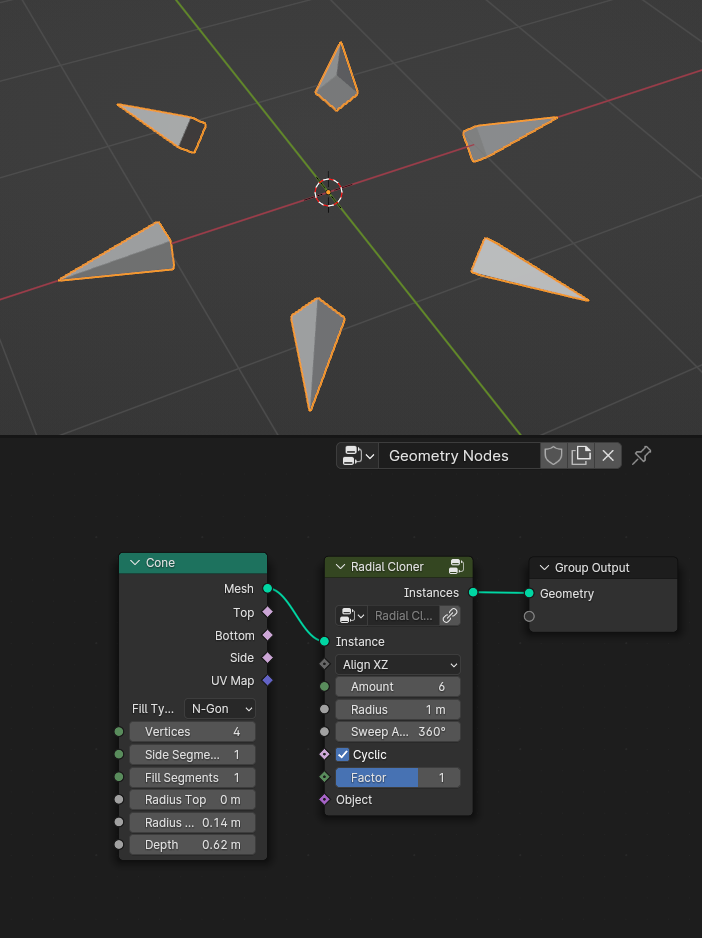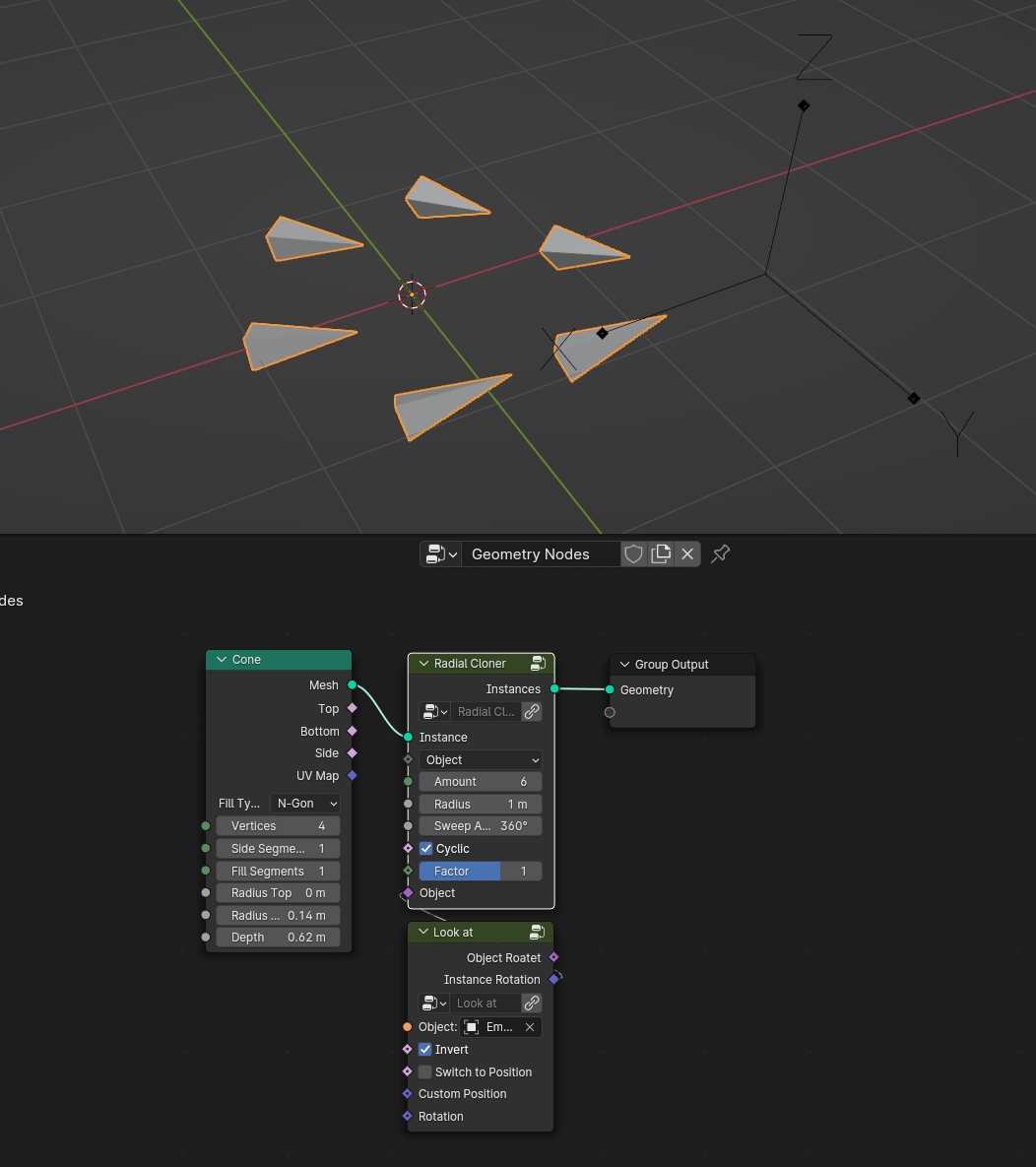
Radial Cloner
Creates instances of an object around a circle. Inside the node, there is an animation system and instance alignment parameters.
Settings
XY/YZ/ZX – plane of the circle
Align X/Y/Z – Align to one of the axes.
Amount – Number of instances
Shape Form – a circle or square with rounded edges
Radius – Radius of the circle
Rotate– Additional rotate
Pick Instance – if there are multiple instances, the instance is placed at a point in the queue orders.
Animation Tab
Curve tabs – settings of the curve along which instances are distributed
- Flip Curve – it changes the direction of the curve, affects the animation and trim.
- Tilt –tilt of the curve affects instances when alignment is applied.
- Rotate – rotates the curve perpendicular to the main axis.
- Center – selects the position of the curve: none; 1 index; free. 1 index means that the curve will be in the place where it starts from. This is convenient if you use multiple cloners and you need to align the position.
Trim Tab – animation of instances along a curve.
- Pin Last index – The last index is forced to stay in its place, which is useful for certain animations.
- To Min/Max – animating the position of instances works like index fields, i.e. the trim gradually affects the position.
Rotate Tabs
Absolute/Index/Inex+ 1 – Absolute mode means that each instance gets the same rotation values. The index means that each instance gets a turn according to its index. That is, the turn is multiplied by the index number. Index +1, adds 1 unit to each index because the indexes start from 0.
Rotate X/Y/Z – Rotate
Offset – offset rotation
Multiplier – The default rotation multiplier should be 1.
Scale Tabs
Absolute/Index – Absolute mode means that each instance gets the same rotation values. The index means that each instance gets a turn according to its index.
Scale – scale
Offset – offset scale
Multiplier – The default rotation multiplier should be 1.